
Research paper · 12 October 2026
From SEO intelligence to governed growth
A practical research paper on AI-enabled SEO tools, data mobility, implementation responsibilities and measurable outcomes.
SEO tools are becoming accessible through AI assistants and are expanding into content, AI visibility and automated analysis. Their role is changing, but current public documentation does not support a blanket claim that they are obsolete. The more useful question is how an organisation turns authorised evidence into a decision, an implemented change and a result it can examine.
Our proposition is additive. Keep useful data, platforms and specialist skills. Define the missing responsibility between them, then test whether a scoped service or integration improves that part of the work. This is a proposed operating method, not a measured claim that SearchGrowthAI outperforms the products reviewed.
This paper reviews official documentation for Semrush, SE Ranking, Ahrefs, Rank Math, Yoast and Screaming Frog, checked on 12 October 2026. The sample deliberately includes intelligence suites, WordPress publishing tools and a technical crawler; these are not interchangeable products. It is a purposive comparison, not a complete market survey or controlled benchmark.
We distinguish four evidence states: documented means the vendor describes a capability; observed means a specific interface or output has been inspected; tested means a defined operation has been reproduced; hypothesis means an explanation or expected benefit still needs validation. Vendor capabilities in this paper are documented, not account-tested. The workflow and procurement recommendations are our own analysis.
SearchGrowthEngine is part of the SearchGrowthAI business. Readers should evaluate the method and evidence with that commercial perspective in mind.
| Tool | Documented development | Question for the buyer |
|---|---|---|
| Semrush | Official MCP for live search and market evidence; access and usage depend on entitlement. | Which fields and date ranges can our account retrieve? |
| SE Ranking | Hosted MCP covering several data and project products. | Which product and operation does this workflow need? |
| Ahrefs | Hosted MCP with plan-based units and limits; programmatic API use is a distinct route. | Is our intended integration supported? |
| Rank Math | MCP includes selected settings changes as well as retrieval. | What could this operation change across the site? |
| Yoast | AI-assisted publishing, structured information and brand-monitoring features. | Which functions does our installed plan actually include? |
| Screaming Frog | MCP-driven crawl and analysis workflows, with incomplete feature coverage. | Can the required crawl operation be reproduced? |
Sources are listed below and linked in the individual comparisons. The finding is limited but consequential: “our system uses AI” is not sufficient differentiation. A service must explain its responsibilities, practical delivery and evidence of value.
“Can we get our data out?” contains several different questions. A CSV export can be useful while omitting configuration, annotations or historical observations. An API can expose a field without granting unlimited storage or redistribution. A dashboard may show an estimate that should not be joined to an analytics session count as if both were measured the same way.
Evaluate mobility at the field and workflow level:
These checks can establish a specific limitation. They cannot establish a vendor’s strategic failure or future financial performance. We make no such prediction.
Start with the business outcome and the audience question. Gather relevant evidence, including the company’s own expertise and first-party measurement. Choose a bounded change. Assign delivery to the existing tool, team or service best able to carry it out. Verify the result before interpreting later performance.
Tool observations + business facts + audience needs. Preserve source and date.
Named owner + exact objects + intended change + dependencies. Record what was done.
Stored and public checks + outcome evidence + next decision. Revisit the original hypothesis.
There is a feedback relationship between these stages. A failed verification returns work to delivery. Weak or contradictory evidence returns the decision to investigation. A poor commercial result may require revisiting the offer, not another metadata edit.
A team keeps its intelligence suite, analytics and CMS. It asks for help connecting a topic opportunity to the right pages, authoritative content and qualified enquiries. SGAI’s scope is the diagnosis and implementation gap. If the team already performs this effectively, retaining its current process may be the best decision.
The site retains its SEO plugin. A scoped engagement clarifies which services need pages, what questions each page should answer and how visitors reach an enquiry. Plugin settings and AI-assisted copy are used where appropriate, with checks against actual business facts. No extra SEO plugin is required merely to use SGAI.
Search research remains in the existing tool, editorial facts remain under editorial control, and event participation remains in the event system. The delivery task connects those records into audience journeys while distinguishing current participation from archive material. A connector can help retrieve or update supported objects; it does not establish the truth of an exhibitor claim.
Use separate levels of evidence. Technical verification establishes whether a change is present and functions. Discovery evidence shows whether relevant audiences may encounter it. Behavioural evidence shows actions such as visits or clicks. Commercial evidence records confirmed enquiries, registrations, purchases or qualified opportunities.
Do not silently substitute one level for another. A contact-link click is not an enquiry received. An estimated traffic figure is not a first-party session count. An AI mention in a monitored prompt set is not universal visibility. A before-and-after increase does not alone prove causation.
Before release, record a comparable baseline, the affected pages and the intervention date. Review after a useful observation period—often an initial 28-day window—while explaining seasonality, small samples, other campaigns and tracking changes. Where possible, use an unchanged comparison group and inspect whether the audience mix changed.
A sensible first pilot selects one page group, one audience need and one evidence-to-change workflow. It should end with a reproducible source record, a prioritised brief, a verified implementation and a review of the outcome data available. Agree what constitutes success before starting; avoid guaranteeing rankings or sales.
Separate professional work, existing software licences, incremental API/AI consumption and ongoing maintenance. Establish a usage cap and escalation point. Price the actual scope rather than presenting a service fee as a substitute for the cheapest software licence.
For SGAI, reporting and agreed implementation are available now. LAB and the SGAI Dashboard are being developed as the client-visible evidence and progress layer. This paper does not claim that every described integration is already deployed or that multi-client agent access is a finished product.
The answer may be better use of an existing platform, additional specialist support or a limited integration. A broad replacement programme should follow evidence, not precede it.
Read the six comparisons · Events and publishing sector paper · Research index · Discuss a scoped project
A card can compose several nuggets: heading, answer, evidence, link and CTA. Each nugget retains its identity; page and ecosystem rules determine its eligible use. The contribution is additive: improve what exists, connect missing steps, and justify expansion.
Search observations inform the blueprint. Business facts, evidence, eligibility and customer journeys determine what can be assembled and published. Technical audit scores alone cannot establish that a page answers the right question or occupies the right position in the mesh.
Explore the working model and its implementation boundaries.
Explore these companion business explanations. Research and technical context remain on SearchGrowthEngine; each illustrated story has its own original article on SearchGrowthAI.
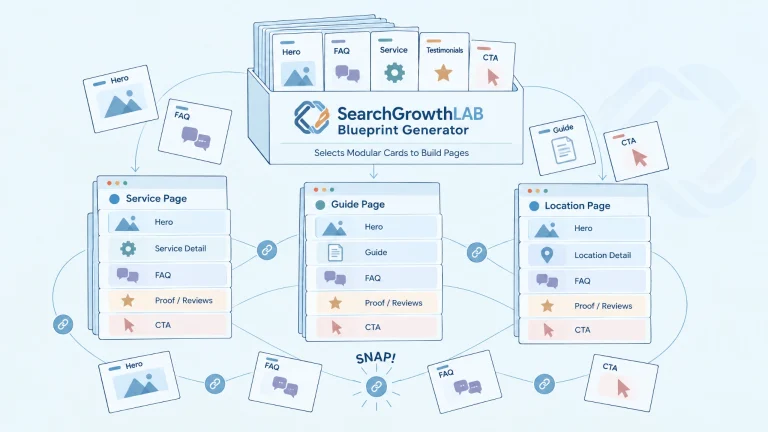
Understand how governed content cards support page composition.
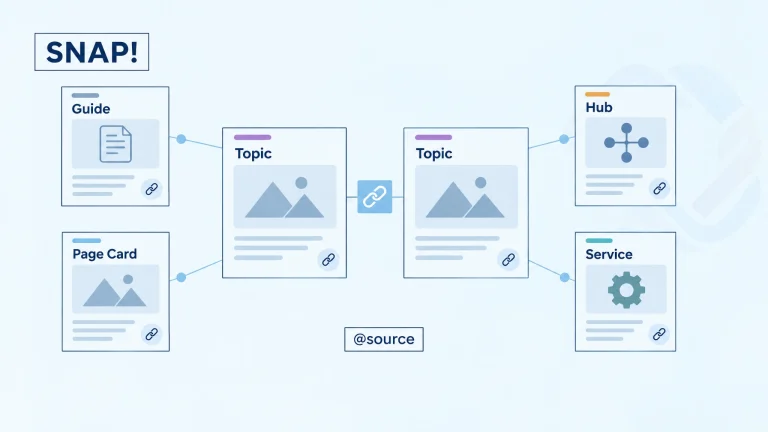
Explain the difference between relevant linking and link volume.
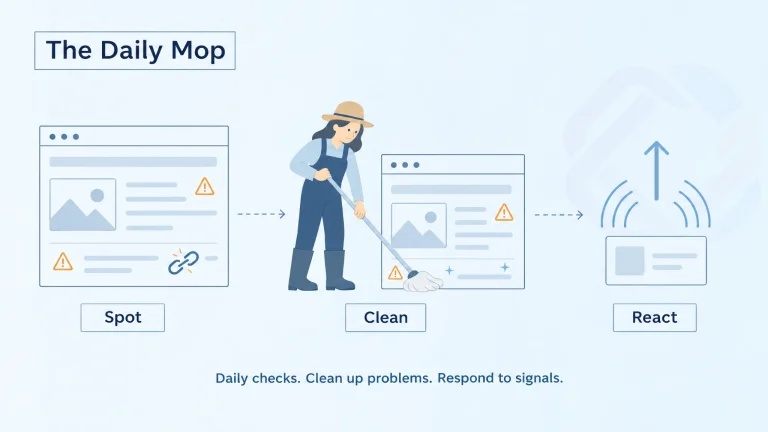
Connect measurements with reviewed operational next steps.