A working thesis about website organisation.
SearchGrowthEngine uses “Search Growth Infrastructure” to describe the organisation of pages, services, products, evidence and customer journeys. It is our planning framework, not a Google standard or a proven ranking formula.
Our hypothesis is that making this information easier to find, understand and maintain gives a business a stronger basis for improving its website.
Test that hypothesis against the website and its data. Our case studies report dated observations and measured activity separately from explanations of what caused them.
Start with information people can use.
It asks whether a site’s pages, products, services, proof, locations and expertise are structured clearly enough to be understood, trusted, compared and reused.
Check existing content before commissioning more.
A content inventory can include website pages, product records, guides, PDFs, videos, reviews and approved case studies.
Look for missing answers as well as duplication, outdated claims and useful material that is difficult to find.
For example, a service page may explain the offer while its supporting case study is isolated elsewhere. Linking the two can give a prospective customer a clearer route to evidence.
Use private emails and internal notes only as research inputs where appropriate. Publish approved information, not confidential source material.

Give the important information a clear place.
Pages
Commercial, informational and support pages need clear roles, relationships and internal pathways.
Products
Product data needs consistent attributes, categories, variants, availability and successor logic.
Services
Service pages need proof, location links, decision support, FAQs and conversion pathways.
Locations
Branches, service areas, properties and destinations need to behave as connected local entities.
Proof
Reviews, case studies, testimonials, awards and press need to support the claims they prove.
Knowledge
FAQs, guides, PDFs, videos and expert answers need to connect back into the wider search system.
AI answers add another discovery surface.
Google’s guidance on AI features says established SEO practices remain relevant and no special AI markup is required.
This supports reviewing crawl access, useful content and internal links alongside any AI visibility investigation.
An AI mention is an observation for a particular response. Record the prompt, platform, date, location and linked source before drawing conclusions.
Measure search visibility and business activity separately.
A citation does not by itself establish traffic, enquiries, revenue or the time taken for a system to understand a message.
Review the relationships between pages.
Ask what a visitor needs next: a service description, price explanation, location, product specification, comparison or supporting example.
Missing relationships are one possible weakness. Poor performance can also involve demand, competition, technical access, the offer or the buying experience.
Use the journey guides to choose the investigation that fits the problem, then inspect the relevant pages and data.
Turn a general concern into a testable change.
For example: connect the relevant case study to a service page, record the date, and monitor use of that route.
Bring familiar website disciplines into one plan.
Pages to entities
A page should represent a clear topic, service, product, location, proof asset or decision pathway.
Content to knowledge
Content should become reusable knowledge, not isolated output published once and forgotten.
Navigation and sitemaps
Use navigation and internal links to connect pages. An XML sitemap helps discovery; it does not replace those links.
Audits to diagnostics
Identify the issue, the evidence supporting it, the proposed change and how success will be assessed.
Optimisation to governance
Assign an owner and review date to important content so that information stays current.
Publishing to authority
Connect useful content with supporting evidence and relevant next steps, then measure the result.
Keep public information consistent across channels.
A business may be found through search results, AI assistants, maps, video, social media, marketplaces or directories.
Choose channels that fit your audience and resources. The same publishing plan will not suit every platform.
Maintain accurate business details, service descriptions, product information and approved claims wherever you publish them.
The business has to become legible beyond its own website.
Consistency is an operating practice; it does not guarantee that every platform will retrieve or represent the information correctly.
Give information a clear owner.
Review whether public descriptions agree with current products, services and policies.
When an AI response contains an error, save the response and inspect its cited sources. Do not assume the website structure caused it or that one edit will correct every future response.
That makes search a stewardship issue. Who owns the information? Which version is correct? Which page is the source of truth? Which service description should be reused? Which product data is current? Which proof asset supports which claim?
Make maintenance part of the plan.
Record who approves information, who can change it and when it should be checked again.
Use tools with an agreed review process.
Tools can help discover gaps, organise information, recommend changes and implement supported tasks. Compare their actual capabilities with the work your team needs.
Our comparison hub explains the overlap between software, analysis and project support. Assign responsibility for checking recommendations before they go live.
Build on what already works.
An improvement project can be additive. A complete redesign is only one possible response to the findings.
Make the thesis testable.
Start with a defined page group, a recorded problem and a small set of changes. Save the baseline and implementation dates.
Choose measures appropriate to the change: discovery, search impressions and clicks, use of internal routes, enquiries or recorded purchases.
Use comparable periods and disclose seasonality, other work and measurement limitations. Improvement after a change does not establish that the change alone caused it.
Clearer information is the objective.
The purpose of this framework is to organise practical work and evaluate it against evidence.
Explore the benchmark layer.
The benchmark series applies this thesis to specific sectors, structures and website systems.
This is a working editorial thesis, reviewed on 15 September 2026. It is not a controlled study, a search-engine requirement or a guarantee of ranking, AI citations or revenue.
Any third-party brands, platforms, search systems or technologies mentioned elsewhere in the research library remain the property of their respective owners. References are used solely to discuss publicly visible website structures, search patterns, digital architecture and market positioning.
Is your website organised clearly enough for modern search?
Start with the assessment or enquire about a paid report and implementation. Share your website address and main concern. Delivery can build on your existing platform; access and capabilities determine the implementation scope. LAB and the SGAI Dashboard are being developed as the client-visible evidence and progress layer.
Related illustrated SearchGrowthAI explanations
Explore these companion business explanations. Research and technical context remain on SearchGrowthEngine; each illustrated story has its own original article on SearchGrowthAI.
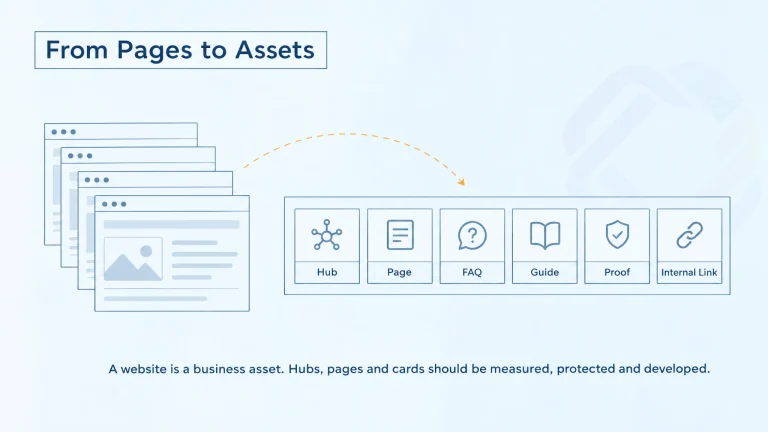
From Pages to Assets
Manage reliable information, links and pages as long-term resources.
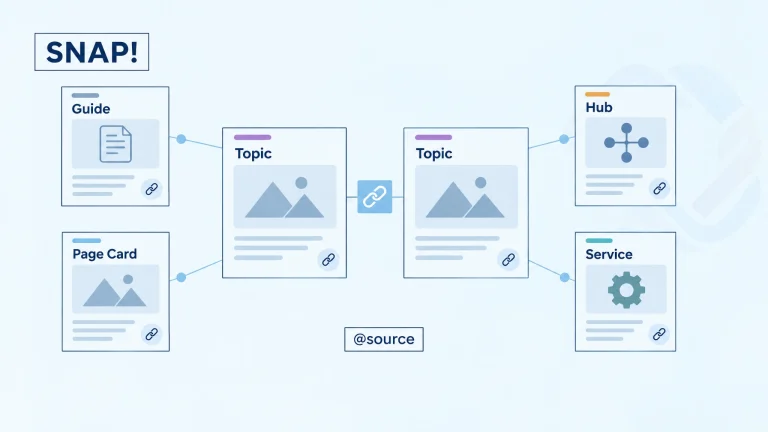
SNAP!
See how useful contextual links connect separate pieces of knowledge.
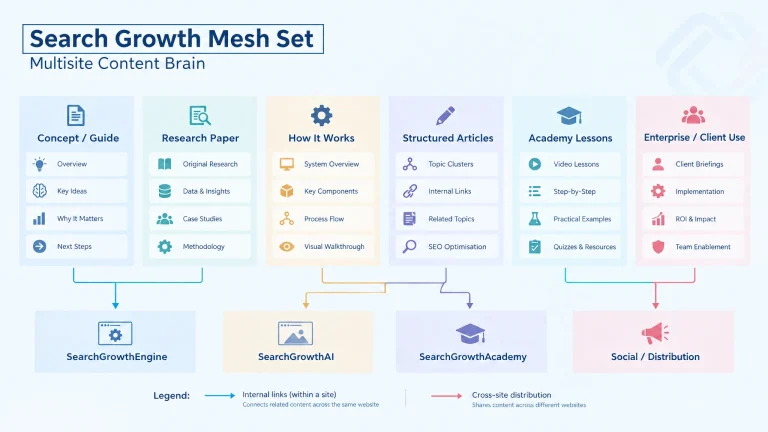
Connected Content Mesh
Translate the infrastructure thesis into an illustrated editorial journey.