
Before
A scale-up topic hub and an R&D visitor hub already exist. They explain the subject, but neither connects the question to a specific evidenced capability.
Website OS is the SearchGrowthAI architecture for connecting business objectives, approved knowledge, website structure, contextual rules and evidence-led delivery. SearchGrowthAI is designed as a governed intelligence and execution layer: it helps determine what should change, who or what may carry out the work, and how the result should be verified and measured.
SearchGrowthEngine explains the framework; SearchGrowthAI provides scoped reporting and implementation; SearchGrowthDesign supports website builds and implementation. The content mesh below shows how this architecture can operate at the level of individual content elements.
| Capability | Role in Website OS |
|---|---|
| Intelligence | Relate business objectives and audience needs to dated evidence. |
| Architecture | Connect entities, nuggets, cards, page assemblies and onward journeys. |
| Governance | Apply source, rights, approval, validity and placement rules before a change is eligible. |
| Execution | Carry out authorised changes through supported tools and responsible operators. |
| Evolution | Preserve versions and decisions, verify affected placements and use measured outcomes to inform the next intervention. |
A nugget is an independently identified element: a heading, answer, image, link, button, CTA or evidence statement. A card can contain many nuggets. A page assembles cards and standalone nuggets for a purpose. The mesh records their relationships, while the control layer applies rules particular to each item, page and ecosystem.
Demonstration boundary: the example below uses fictional event and supplier information. Open each stage to inspect a generated page state. These are publication-time examples of a tested small rule model, not a live customer data connection or a production control plane.
The content brain is an industry-neutral model. It connects approved knowledge to the pages where it is useful. Each placement has its own purpose, audience and next step; sharing a nugget does not mean copying an entire page.
| Context | Reusable knowledge | Rules and onward journey |
|---|---|---|
| Services | A capability answer and supporting case study | Service area and evidence determine eligibility; a relevant page leads to an enquiry. |
| Products | A specification, compatibility answer or care instruction | Product variant and current availability determine placement; the next step leads to the appropriate product. |
| Research and education | A sourced explanation, finding or definition | Source date, rights and claim scope determine reuse; readers can inspect the evidence and related guidance. |
| Events and publishing | A capability card, speaker answer or historical briefing | Edition and confirmed participation determine current actions; useful historical knowledge keeps its date. |
Suppose a business has a service page and a buying guide. Both need to answer “What is included?” A shared card can combine the approved scope answer, dated evidence and an action nugget. The service page can offer an enquiry; the guide can lead readers to the detailed service description.
If the service scope changes, identify both placements, prepare the new answer version, check each contextual action, publish and verify both pages. Keep the earlier version in the change record. This is a proposed procedure: automated propagation requires a validated implementation.
Your operators continue their research, audits and editorial work. SGAI connects the selected evidence to business knowledge, a proposed change and its affected pages. The authorised publishing system applies that change; the team verifies the visitor journey and measures outcomes separately from tool scores.
Semrush workflow · SE Ranking workflow · Ahrefs workflow · Rank Math workflow · Yoast workflow · Screaming Frog workflow
The following fictional example makes time-dependent rules visible. It is one application of the wider model, not a representation of any named organiser, exhibitor or customer system.
A scale-up topic hub and an R&D visitor hub already exist. They explain the subject, but neither connects the question to a specific evidenced capability.
A shared capability card combines a heading, an approved answer, a historical evidence link, edition-specific participation and a contextual CTA.
Both hubs gain a relevant route. They retain their own questions and purpose while using the same approved capability. Existing content becomes more useful.
| Placement | Contribution | Onward journey |
|---|---|---|
| Scale-up topic hub → shared capability card | Answers “Who can help assess readiness?” | Historical proof → eligible meeting or topic route |
| R&D visitor hub → the same card | Helps the visitor plan relevant expertise to explore | Capability profile → confirmed current action |
| Card → five distinct nuggets | Composes a heading, answer, evidence, participation and CTA | Rules evaluate each eligible part |
| Semrush operator → blueprint decision | Research and monitoring inform a proposed addition | Business owner validates knowledge; CMS publishes approved output |
A new placement needs a reason, relevant incoming links and a useful next step. Shared identity does not justify placing every card on every page.
Who can help us assess scale-up readiness?
Discuss pilot-to-production requirements, process constraints and analytical validation.
Historical briefing. This does not establish participation in any later edition.
Only offer an archive item when it exists and is approved.
This is a local demonstration destination. No booking, meeting or registration is submitted. A deployment would use the organisation’s approved operational route.
Who can help us assess scale-up readiness?
Discuss pilot-to-production requirements, process constraints and analytical validation.
Confirmed current participation — fictional fixture only.
A current meeting route requires separately confirmed current participation and an available destination.
This is a local demonstration destination. No booking, meeting or registration is submitted. A deployment would use the organisation’s approved operational route.
Who can help us assess scale-up readiness?
Discuss pilot-to-production requirements, process constraints and analytical validation.
Participation pending. Historical expertise may remain useful, clearly labelled.
Do not carry current participation into the next edition. Withhold meeting and registration claims until eligibility is established.
This is a local demonstration destination. No booking, meeting or registration is submitted. A deployment would use the organisation’s approved operational route.
| Nugget | Own identity and evidence | Contextual rule |
|---|---|---|
| Heading | N-01 · company name fixture | Render at the appropriate heading level; a card does not introduce a second page H1. |
| Answer | N-02 · approved capability, versions 1 and 2 | Reuse the eligible version across both placements. |
| Evidence | N-03 · historical briefing, edition 2026 | Retain edition and provenance; omit unavailable evidence. |
| Participation | N-04 · confirmation for edition 2027 | Never infer 2028 participation from 2027. |
| CTA | N-05 · action label and destination | Select the appropriate available action for the eligible stage. |
Version 1: Discuss pilot-to-production requirements and process constraints.
Version 2: Discuss pilot-to-production requirements, process constraints and analytical validation.
Affected placements: the scale-up topic hub and the R&D visitor hub. The change adds a useful answer to both; the historical evidence and participation records remain distinct. Publishing to multiple real sites still requires supported adapters and verification.
The change record should preserve the source, approval, rule version, affected placements and before/after output. A page can evolve because knowledge, composition or rules change; those are different interventions.
Record an interaction against the page, card, nugget, placement and version the person encountered, where measurement and consent permit it. Keep observed clicks, saved enquiries, registrations and commercial outcomes distinct. This walkthrough displays no customer traffic or conversion results.
A next-step plan might investigate manufacturing-capacity questions or another audience. Add the new answer only when evidence and a useful position in the mesh justify it.
Our service home is SearchGrowthAI at searchgrowth.ai; the framework and educational material are published at SearchGrowthEngine at searchgrowthengine.com. Start with an assessment or a scoped implementation discussion. This architecture page does not provide a universal Website OS plugin, API-key installer or hosted MCP endpoint. Any connection is specified and authorised for the actual site, platform and operator.
Scoped reporting and implementation are available. This public walkthrough demonstrates generated page states and a small rule model. A normalised nugget, version and rule runtime, automatic propagation across sites, and a client-visible LAB/dashboard require further implementation and validation. The demonstration does not establish those as finished production capabilities.
MCP is an authorised connection for a configured tool or agent. It does not replace public web pages, sitemaps or crawlable links, and it does not establish that a public search engine can access private business context. Public discoverability must be tested separately.
Execution depends on agreed scope, current permissions, supported adapters and the applicable approval rules. Source checks, conflict handling, affected-page verification and a recovery route belong to the delivery process. This page does not promise unrestricted autonomous deployment.
This page describes our architecture and working methodology. It does not announce an open-source software release or licence. Any software distribution would need its own published licensing terms.
A dated AI answer can show how a discovery system describes a business. It does not validate its implementation or establish a commercial outcome. Keep mentions, explicit citations, organic search listings and confirmed customer actions as separate observations.
This method can use existing research tools and publishing systems. Account access, source ownership and runtime behaviour must be validated for each implementation.
Follow the Semrush operator workflow · Apply this to events and publishing · Explore the service · Explore implementation
Explore these companion business explanations. Research and technical context remain on SearchGrowthEngine; each illustrated story has its own original article on SearchGrowthAI.
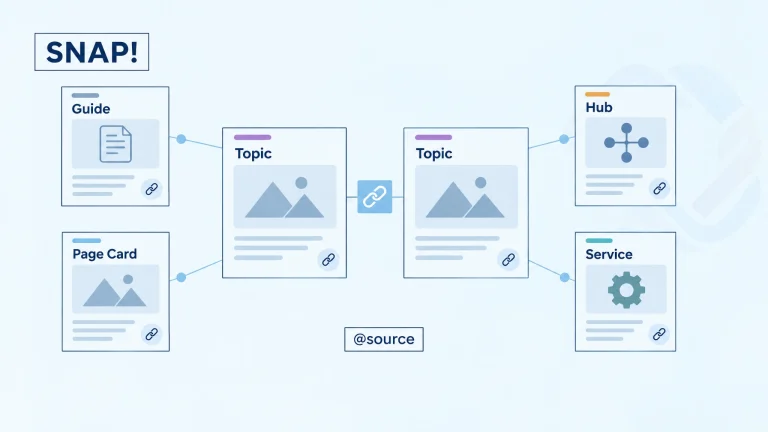
How one relevant card can connect a related concept or useful next step.
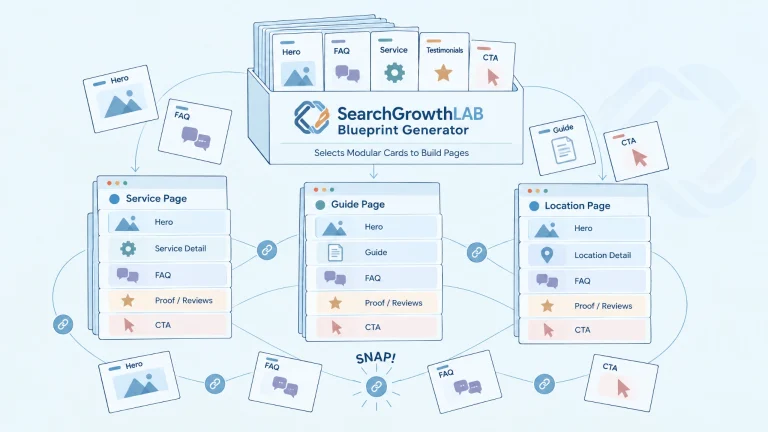
Explore the modular page composition idea behind reusable cards.
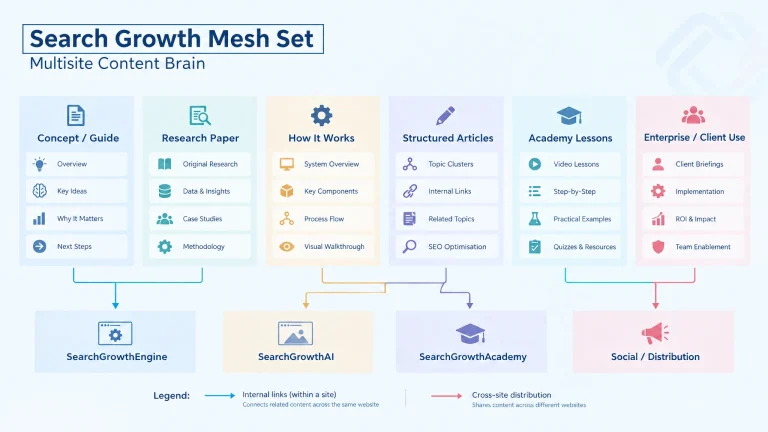
See the editorial network linking research and business explanations.