
Plan what happens when products sell out.
A practical framework for reviewing seasonal products, useful archive pages, genuine replacements and URLs that should be removed. The right choice depends on the product and the customer’s need.
Review the journey beyond the live product.
This article uses Zara, H&M and Uniqlo as a starting point for questions about fashion retail. The scenarios below are hypothetical; they do not report findings from an audit of those businesses.
No comparable crawl dataset or product-lifecycle study is presented here. A brand-specific benchmark would need dated URL samples, observed status codes and consistent testing conditions.
That may be a useful archive, a genuine replacement, or a correctly removed page. A redirect is not always the right answer.
Use this as a review framework.
The three scenarios below cover seasonal turnover, broad catalogues and recurring product families. They describe possible operating situations rather than verified characteristics of the named retailers.
It is not a ranking of the brands. It does not claim to measure their internal systems, rankings, AI visibility, redirect rules, stock handling or commercial performance.
Apply the questions to your own catalogue and record the evidence before deciding which URLs to retain, redirect or remove.
The question is whether the website remains useful and accurate after availability changes.
Product turnover needs an explicit review process.
A catalogue may contain seasonal stock, changing variants and regional differences in price or availability.
Review the exact product, its ongoing usefulness and any genuine replacement. Do not assume that a broad category is an equivalent destination for every retired item.
Google’s HTTP status guidance explains that URLs returning 404 or 410 are removed from its index over time. That can be the correct outcome for removed content.
Check whether demand remains before deciding what to retain.
Three models. Three different preservation challenges.
Scenario: seasonal turnover
The challenge is not only launching new products quickly. It is preserving product meaning when trend-led items move through the catalogue quickly and may not return in the same form.
Scenario: broad catalogue
The challenge is keeping broad ranges, variants, regional stock, category logic and product attributes coherent enough for users, search engines and AI systems to understand.
Scenario: recurring product family
The challenge is using recurring product families, basics and functional apparel concepts as durable entities, while keeping global and local execution aligned.
What a fashion retail benchmark should look for.
Start with a dated sample of products and categories. Google’s ecommerce navigation guidance recommends links through categories to products; assess those routes alongside URL handling.
| Benchmark signal | Why it matters | Seasonal scenario | Broad-catalogue scenario | Recurring-family scenario | What good looks like |
|---|---|---|---|---|---|
| URL lifecycle | Check a dated sample of status codes and destinations. | Record what happens at season end. | Sample variants as well as main products. | Check changes between editions. | Retain useful pages, redirect equivalent replacements, or remove appropriately. |
| Category navigation | Test paths from categories to current products. | Check collection changes. | Check pagination and filters. | Check product-family links. | Products intended for discovery have crawlable internal links. |
| Attribute accuracy | Compare visible details with source records. | Check seasonal descriptions. | Check size, colour and regional data. | Check version-specific specifications. | Details remain accurate and consistent. |
| Replacement decisions | Verify that a target fulfils the old purpose. | Avoid redirecting all stock to a collection. | Review mappings at product level. | Distinguish an update from a different model. | Use justified mappings and labelled alternative links. |
| Archive usefulness | Identify continuing customer needs. | Check care or support needs. | Avoid keeping empty templates. | Keep useful model history where justified. | Archives explain retirement and provide useful information. |
| Regional consistency | Check the tested country and language. | Record local stock. | Check variant and price differences. | Check local launch and retirement dates. | Each regional page describes its actual offering. |
The issue is one product truth with localised execution.
A fast-moving global retailer may have seasonal product turnover, regional inventory variation, localised URLs, product variants, collection pages, category pages and country-specific ecommerce experiences.
The infrastructure challenge is to stop those localised execution layers from fragmenting the underlying product truth.
Keep product attributes and regional availability accurate. Link products to useful categories and record whether a replacement is truly equivalent.
The 404 Ghost Problem.
“404 Ghost Problem” is our shorthand for a removed product URL that still receives relevant visits or demand. It is not an official Google term, and a 404 response is not inherently a mistake.
Check search queries, referral links, customer support needs and current stock before deciding whether an old product page still serves a purpose.
A useful archive may be worth retaining. If there is no useful content or replacement, removal can be appropriate.
Offer relevant alternatives as clearly labelled links. Use a permanent redirect when the replacement genuinely fulfils the old page’s purpose; do not redirect every removed product to a generic collection.
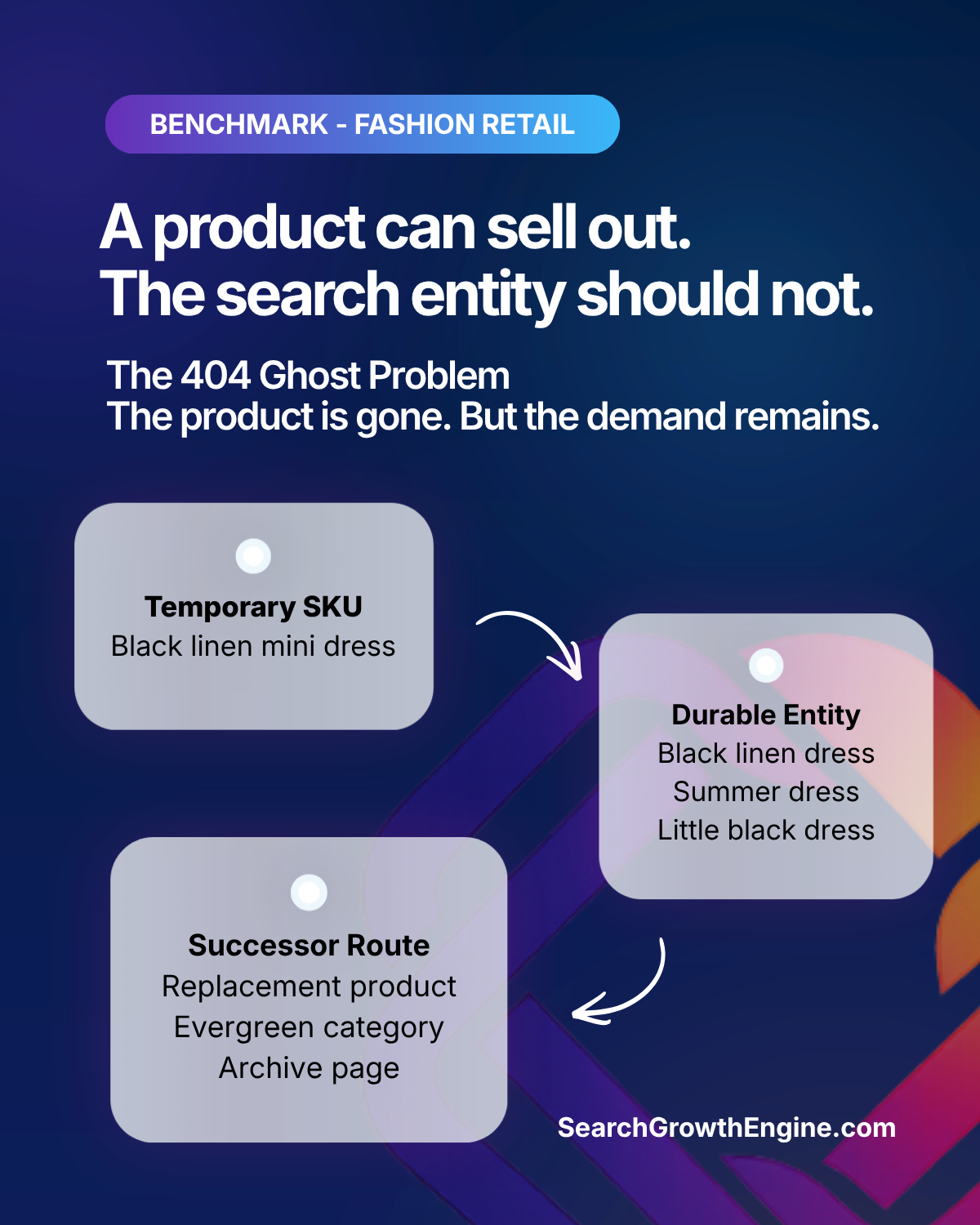
A fast-fashion black linen mini dress should have an exit plan.
Consider this hypothetical example rather than a measured retailer result.
A seasonal black linen mini dress receives visits and then sells out. First establish whether it will return and whether customers still need its details.
Its specification, care instructions or support information may remain useful even when purchase is unavailable.
Temporary SKU
The exact seasonal product: for example, a black linen mini dress in a specific collection, size range and region.
Durable product entity
The reusable idea behind the product: black linen dress, summer dress, little black dress, holiday dress or capsule wardrobe basic.
Successor route
A genuine replacement may justify a redirect. A broader collection can be offered as a labelled alternative without pretending it is the same product.
Keep useful information when justified and make availability clear.
Choose retention, replacement or removal deliberately.
When a product is temporarily sold out, the page can remain live with an honest unavailable message, clear alternatives and structured availability information.
For permanent retirement, retain an archive only if it remains useful. Use a suitable permanent redirect for an equivalent replacement; otherwise a 404 or 410 may be appropriate. See Google’s redirect guidance.
The guiding question is what best serves someone following the old product URL.
Give each product a lifecycle rule.
Still in stock
Keep the live product page focused on ecommerce intent, while exposing clear product attributes and related categories.
Low or temporarily out of stock
Keep the page useful with availability clarity, similar styles, related materials, colour pathways and category links.
Retired with a close replacement
Redirect or route users to the successor product where the intent and product match are genuinely close.
Retired without a replacement
Retain useful reference content if justified; otherwise return 404 or 410. Do not force a redirect to an unrelated product or category.
High-demand expired product
Consider a clearly labelled archive when ongoing searches or customer needs justify it. Keep the details accurate and avoid implying it is still for sale.
Low-value expired product
Remove the page with an appropriate status when it has no useful content or equivalent replacement. Update internal links and the sitemap.
Make availability and replacements explicit.
A retained page should clearly state that the product is unavailable or retired. Describe any replacement accurately, and label alternatives as alternatives.
This improves the clarity of the customer journey. It does not guarantee that search signals or AI citations will transfer to another URL.
The commercial lesson applies beyond big retailers.
This benchmark is not only about large fashion brands. The practical lesson is highly relevant to smaller ecommerce retailers.
A small fashion brand may not need enterprise infrastructure, but it does need durable collection pages, standardised product attributes, sensible redirects and a simple successor rule for seasonal products.
Maintain a product-lifecycle register: current status, next action, destination if any, reason, owner and review date. Compare the results after changes using suitable periods.
Does the old URL still provide useful, accurate information, and is its status appropriate?
The structure behind fashion retail search growth.
Product entity clarity
Whether products belong to durable concepts, categories, styles, materials and occasions beyond the live SKU.
Collection architecture
Whether categories and collections preserve recurring demand when individual products change or expire.
Regional sitemap logic
Whether localised versions support one coherent product truth rather than fragmenting authority.
Structured attributes
Whether colour, material, fit, length, season, occasion and style information is consistent enough to support discovery.
Successor mapping
Whether retired products have a documented retention, replacement or removal decision.
Comparison readiness
Whether product data is easy for users, search engines and assistants to compare, filter and reuse.
Keep catalogue changes useful and measurable.
Products change. Review the pages, links and availability information alongside those changes.
The framework helps teams make consistent decisions; its value should be evaluated against customer needs and observed performance.
SearchGrowthAI offers paid reporting and implementation for agreed website priorities. Our case studies provide separate project evidence and do not verify the hypothetical retail scenarios on this page.
Retain useful content, redirect genuine replacements, and remove pages appropriately.
Explore connected benchmark themes.
Fashion retail connects to digital scale, product data governance and practical ecommerce guides.
Scale is not search infrastructure
How large content and product ecosystems still need clear governance and entity structure.
Read the benchmarkPractical guides for ecommerce retailers
Turn benchmark ideas into useful actions for product, collection and seasonal search growth.
View guidesThe Search Growth Infrastructure Thesis
A working framework for organising pages, evidence and customer journeys.
Read the thesisThis editorial framework was reviewed on 15 September 2026. The scenarios are hypothetical. It is not a measured comparison of Zara, H&M or Uniqlo, nor evidence of their rankings, internal systems, AI visibility or commercial results.
Any third-party brands, company names, trademarks or platform references mentioned remain the property of their respective owners. References are used solely to discuss publicly visible ecommerce structure, product information architecture and search growth patterns.
SearchGrowthEngine and SearchGrowthAI are not affiliated with, endorsed by, or officially connected to the organisations referenced unless explicitly stated otherwise.
Need help reviewing your product lifecycle?
Start with the assessment or enquire about a paid report and implementation. Share your website address and main concern. Scope depends on platform access and capabilities; LAB and the SGAI Dashboard are being developed as the client-visible evidence and progress layer.